
Is Executive Coaching Worth It? Lessons From Coaching 2,500 Leaders Over 25 Years
I have been asked some version of this question hundreds of times: Is executive coaching actually worth it?
Every year, leaders invest in coaching, training, assessments, and development programs that promise meaningful change. Some deliver. Many don’t. The people asking me this are smart and inherently skeptical. They have invested in leadership programs, training initiatives, and development efforts before. Some helped. Some didn’t. Their skepticism is warranted.
Let me answer the question the same way I would if we were sitting across a table from each other.
In 25 years of coaching more than 2,500 leaders at companies like Google, Amazon, and Microsoft, I have seen executive coaching transform careers. I have also watched it fail. The question of whether executive coaching is worth it does not have a simple yes or no answer. What I have learned is that coaching works remarkably well under the right conditions and disappoints under the wrong ones.
After 2,500 engagements, I can tell you that the condition that matters most is almost never what leaders expect. People rarely fail because they lack talent. They struggle because they cannot see themselves as clearly as others see them.
The Honest Answer (Not What Most Coaches Will Tell You)
The honest answer is yes. I’ve seen coaching help leaders earn promotions, become more influential, and lead more effectively in high-stakes situations.
But here’s what most coaches won’t tell you: coaching is not the magic. The leader’s willingness to change is.
Over the years, I have learned that coaching is not something a coach does to a leader. It is a partnership. The leaders who benefit most are willing to hear difficult feedback, challenge their own assumptions, and make meaningful changes in how they lead.
Organizations play an important role by providing ongoing feedback, reinforcing desired behaviors, and supporting the leader’s development. When leaders are committed to growth and the organization actively supports that development, coaching can be transformative. When either is missing, progress is often slower and less sustainable.
Let me give you two examples from my practice.
When Executive Coaching Works (And When It Does Not)
A VP at a Fortune 500 company came to me after being passed over for promotion twice. Her performance was strong, but she was not viewed as operating at the executive level. While highly capable, she struggled to project confidence and authority in high-stakes meetings. Through coaching, she strengthened her executive presence and became more influential in senior leadership discussions. Senior leaders began seeking out her perspective, her voice carried more weight, and she was increasingly viewed as someone ready for a larger leadership role. Within six months of completing the engagement, she was promoted to Senior Vice President.
Not every coaching engagement is about promotion. One director at a global technology company was receiving consistent feedback that he was not concise. He was deeply knowledgeable, but his tendency to over-explain often buried his key message. In executive settings, losing the room meant losing influence. Through coaching, he learned to lead with his recommendation, focus on what mattered most, and recognize when he had said enough. Within a year, senior leaders were actively seeking his input on high-stakes decisions he had previously been left out of.
The leaders in those examples experienced meaningful growth, but not every coaching engagement produces those results like these. That’s why I hesitate when people ask whether executive coaching is worth it.
I have also seen organizations expect coaching to solve problems that coaching cannot solve. Sometimes the real issue is a dysfunctional culture, unclear expectations, poor leadership from above, or a lack of accountability across the organization. Coaching can help leaders navigate these challenges, but it cannot fix a broken system.
I’ve also worked with leaders who entered coaching because someone else thought they should. They attended sessions, participated in discussions, and completed assignments, but they never truly committed to changing how they led. The issue was not capability. The issue was readiness. Coaching can create awareness and provide accountability, but it cannot create the desire to change.
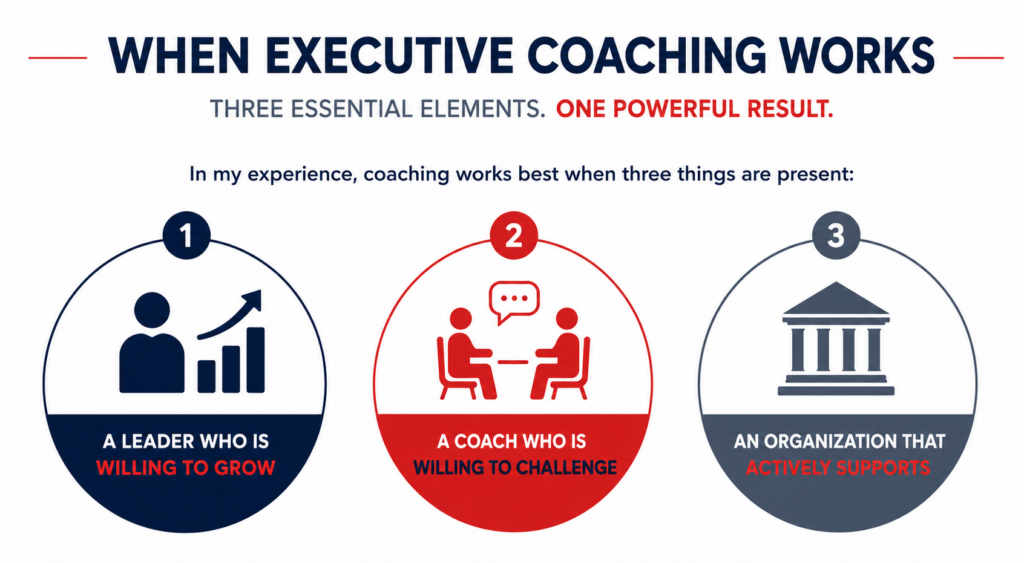
In my experience, coaching works best when three things are present: a leader who is willing to grow, a coach who is willing to challenge, and an organization that actively supports the development process. When those elements come together, the results can be significant. When one of them is missing, progress is often slower and less sustainable.
What the Research Says About Executive Coaching ROI
After 25 years in this profession, the research confirms what I have watched play out in real careers.
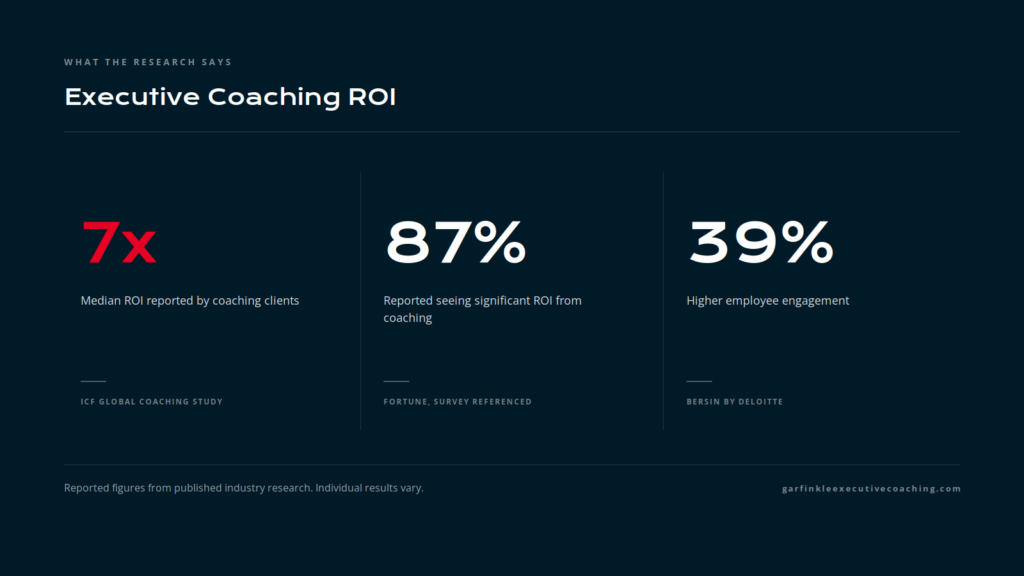
The ICF Global Coaching Study found that the median ROI reported by coaching clients is 7x the initial investment. A Fortune analysis of executive coaching referenced a survey in which 87% of respondents reported seeing significant ROI from coaching. The idea that coaching can create meaningful value is not limited to research studies. Former Google CEO Eric Schmidt, who worked with a coach for approximately 15 years, once called hiring a coach the best professional decision he ever made. Amazon founder Jeff Bezos and Microsoft founder Bill Gates have similarly spoken about the value of outside counsel during critical leadership moments.
At the same time, Harvard Business Review’s landmark article, What Can Coaches Do for You?, highlights an important reality: coaching is not a one size fits all solution. Not every coach is equally effective, not every leader is equally coachable, and not every coaching engagement produces the same results.
Understanding why executive coaching is important starts with recognizing that the greatest return rarely comes from learning something new. It comes from changing how a leader thinks, communicates, and shows up every day.
The research and real-world examples make a strong case for coaching. But in my experience, ROI rarely appears as a single metric you can point to. More often, it becomes visible through meaningful changes in a leader’s effectiveness and impact. A leader earns a promotion, becomes more influential with senior stakeholders, strengthens executive presence, improves team performance, or successfully navigates a larger leadership role.
The impact often extends beyond the individual leader. Bersin by Deloitte found that organizations with strong coaching cultures report stronger business results and 39% higher employee engagement than their peers. When leaders communicate more effectively, build stronger relationships, and make better decisions, the benefits ripple throughout the organization.
The most meaningful returns are often the hardest to quantify. A leader becomes more confident under pressure. Their judgment improves. Relationships strengthen. People listen differently when they speak. What I have seen over and over is that these changes create opportunities that continue compounding long after the engagement ends.
Three Questions to Ask Before Hiring an Executive Coach
Before investing in coaching, I encourage leaders to ask themselves three questions.
1. Am I willing to hear what I may not want to hear?
The leaders who gain the most from coaching are often the most open to feedback. Coaching works best when you are willing to examine blind spots, challenge long-standing assumptions, and make meaningful changes in how you lead. If you are looking for encouragement alone, coaching may disappoint you. If you are willing to learn and grow, it can be transformative.
2. Do I have a specific goal, challenge, or leadership transition I am trying to navigate?
Coaching is most effective when it has a defined focus. That could be earning a promotion, increasing influence, improving stakeholder relationships, or preparing for a larger leadership role. The clearer the objective, the easier it is to measure progress and success.
3. Am I choosing a coach based on fit, experience, and results, or am I focused primarily on brand and price?
Before hiring a coach, look beyond their reputation, marketing, or fees. Consider whether they have experience helping leaders achieve outcomes similar to the ones you are seeking. Just as important, choose a coach you trust enough to be honest with and who will challenge you when needed. The strongest coaching relationships are built on trust, candor, and accountability.
What 2,500 Coaching Engagements Have Taught Me
If there is one lesson I have learned after 25 years, it is this: people rarely fail because they lack talent. I’ve coached brilliant executives who struggled and average performers who exceeded every expectation. More often, they struggle because they cannot see themselves as clearly as others see them. The difference comes down to self-awareness, adaptability, and a willingness to change.
The leaders who grow the fastest are not the smartest people in the room. They are the ones willing to sit with hard feedback, explore uncomfortable questions, and challenge habits that no longer serve them. They bring their hardest problems to sessions. They do the work between them.
Coaching creates the space for that process. It provides honest feedback, accountability, and perspective. But it is not magic. It does not eliminate hard work or guarantee outcomes. What it can do is help you accelerate growth, navigate challenges more effectively, and become more intentional about how you lead.
Twenty-five years in, I am more convinced than ever that the right coaching relationship, at the right time, with a leader who is ready to grow, can accelerate growth, expand influence, and change the trajectory of a leader’s career.
So, is executive coaching worth it? The answer is yes, but only when coaching is matched with a genuine commitment to learn, accept honest feedback, and put new behaviors into practice.
If you’d like to explore whether executive coaching is the right investment for your situation, I invite you to schedule an initial conversation. We’ll discuss your goals, the challenges you’re facing, and whether coaching is the right fit for what you’re trying to achieve.
|