
What Does an Executive Coach Do? Here Is What Actually Happens
The first thing most clients say in our initial conversation is some version of: “I’ve never worked with an executive coach before. What does an executive coach do?”
Most articles answer that question with a generic definition of coaching. But after coaching more than 2,500 leaders over the past 25 years, I can tell you that executive coaching is much more practical than most people realize.
Recently, I’ve helped a senior leader strengthen executive presence, coached a newly promoted VP preparing for a larger leadership role, and worked with a director who needed to improve influence across the organization.
What an Executive Coach Actually Does
At its core, executive coaching is a behavior change process. The goal is to help leaders understand how others perceive them, identify the behaviors that are helping or limiting their leadership impact, and make meaningful changes that improve performance. The International Coaching Federation (ICF) defines coaching as a partnership that helps clients maximize their personal and professional potential.
That gap between intention and impact is where coaching often begins. My first responsibility is helping leaders understand the impact they have on others and how that differs from their intentions. Through stakeholder interviews, 360 feedback, assessments, and direct conversations, we identify the behaviors that are helping or limiting their effectiveness. Many of these patterns are difficult for leaders to see on their own. This emphasis on feedback and self-awareness is consistent with leadership development approaches used by organizations such as the Center for Creative Leadership (CCL).
But awareness alone rarely creates lasting change. I help leaders test new approaches in real workplace situations, evaluate what works, make adjustments, and reinforce new behaviors over time.
For example, a leader may need to become more influential with senior executives, communicate more concisely, strengthen executive presence, delegate more effectively, lead with greater confidence, or navigate difficult stakeholder relationships. Every coaching session connects directly to situations the leader is facing right now.
My role is to provide honest feedback, challenge assumptions, identify blind spots, create accountability, and help leaders apply new behaviors until they become part of how they naturally lead.
Coaching is not simply about greater self-awareness. The goal is visible leadership change that other people can see, experience, and recognize.
A Typical Coaching Engagement: From First Call to Final Review
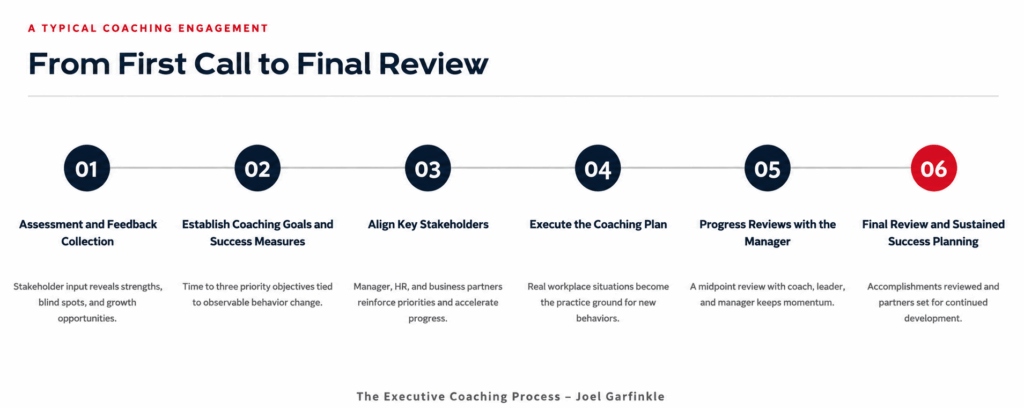
While every coaching engagement is customized, I typically follow a similar six-step process.
Step 1: Assessment and Feedback Collection
I begin by understanding the leader’s role, goals, challenges, strengths, and development priorities. I also gather feedback from key stakeholders, which may include the manager, peers, direct reports, and business partners. This process reveals strengths, blind spots, and opportunities for growth that shape the coaching engagement.
Step 2: Establish Coaching Goals and Success Measures
Using the information gathered during the assessment process, we identify the two to three highest-priority coaching objectives. These goals are tied to leadership performance, business impact, and observable behavior change. We create a focused development plan with measurable outcomes and accountability built into the process.
Step 3: Align Key Stakeholders
Coaching is most effective when key stakeholders support the leader’s development. Depending on the situation, this may include the manager, HR, business partners, or senior leaders. Their involvement reinforces priorities, provides feedback, and accelerates progress.
Step 4: Execute the Coaching Plan
During our coaching sessions, we focus on the objectives established at the beginning of the engagement and use real workplace situations to apply and strengthen new behaviors. Current challenges, difficult conversations, stakeholder relationships, and upcoming presentations become opportunities to practice, receive feedback, and make adjustments.
Step 5: Progress Reviews with the Manager
Throughout the engagement, the leader maintains ongoing dialogue with their manager regarding coaching progress. At the midpoint, the coach, leader, and manager review progress, gather feedback, and make adjustments as needed. This process reinforces accountability and maintains momentum.
Step 6: Final Review and Sustained Success Planning
At the conclusion of coaching, the coach, leader, and manager review accomplishments, leadership growth, and progress against the original objectives. We discuss how to sustain momentum moving forward and identify priorities for continued development.
The ultimate measure of success is simple: the leader changes behavior, other people notice the difference, and organizational results improve. This focus on observable behavior change and stakeholder feedback is central to how I evaluate coaching impact. It is also consistent with research on executive coaching published by Harvard Business Review.
What an Executive Coach Does NOT Do
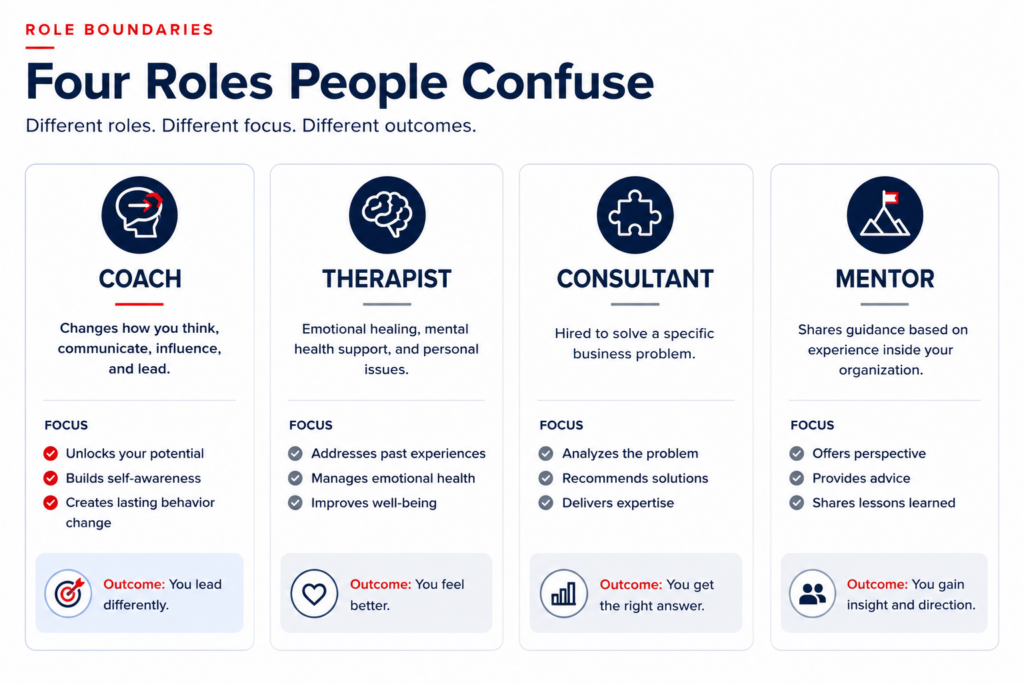
Many people confuse executive coaching with therapy, consulting, or mentoring. While all can be valuable, they serve very different purposes.
An executive coach is not a therapist. If your primary goal is emotional healing, mental health support, or working through personal issues, therapy may be the right choice.
An executive coach is not a consultant. Consultants are typically hired to solve a business problem. Executive coaching focuses on helping leaders become more effective in how they think, communicate, influence, and lead.
An executive coach is not a mentor. Mentors are often senior leaders inside the organization who share guidance based on their experience. Executive coaching provides an objective perspective focused on helping leaders navigate challenges and achieve their goals.
Executive coaching focuses on something different: helping successful leaders translate awareness into action and insight into behavior change. Most leaders already know they need to communicate more effectively, build stronger relationships, increase their influence, or delegate more strategically. The challenge is rarely a lack of knowledge. The challenge is consistently doing it.
Coaching success is not measured by the insights you gain. It is whether you apply those insights in ways that strengthen your leadership and improve results.
Who Hires an Executive Coach (And Why)
The leaders who benefit most from coaching tend to arrive at one of these inflection points:
Addressing difficult feedback or leadership blind spots.
A manager, stakeholder, or 360 assessment has highlighted behaviors that are limiting your leadership success. You may be unaware of how others experience you, or you may know exactly what needs to change but struggle to make the change stick.
Preparing for a VP, SVP, or C-suite position.
The skills that helped you succeed in your current role may not be enough at the next level. Leaders preparing for more senior positions often need to strengthen their executive presence, strategic thinking, communication, and influence before the opportunity arrives.
Improving executive presence and communication.
Coaching helps leaders become more confident, credible, and influential by communicating with greater clarity, speaking with conviction, and earning trust and respect.
Increasing influence with senior stakeholders.
Many leaders struggle to gain support, build alignment, and influence decisions across the organization. Coaching helps leaders strengthen relationships, navigate organizational dynamics, and become more influential with executives and key stakeholders.
Navigating a new role or larger leadership challenge.
Whether you’re stepping into a bigger role, leading a larger team, or taking on broader responsibilities, coaching can help accelerate your transition and increase your effectiveness.
Most clients begin noticing measurable change within six to nine weeks. The full engagement typically runs six to nine months because sustainable behavioral change takes time to become permanent.
How do I become an executive coach?
If you’re researching how to be an executive coach, the most common path includes leadership experience, formal coach training, and professional certification through organizations such as the International Coaching Federation (ICF). This article, however, is intended for leaders and organizations evaluating executive coaching.
Article Categories
Share Article
[Sassy_Social_Share]
|