
Influence Without Authority: How to Lead When No One Reports to You
One challenge has become increasingly common in my executive coaching conversations. Senior leaders are not struggling to manage their own teams. They are struggling to move people who do not report to them at all: peers in other departments, stakeholders several levels up, leaders in other business units, or executives who control the budget they need. This is influence without authority, and today it is the single most common leadership challenge I hear in executive coaching.
This challenge has become far more common as organizations have become flatter and more collaborative. Major initiatives now span multiple functions, requiring leaders to gain commitment from peers and stakeholders with different priorities and competing demands. In this environment, formal authority is no longer enough.
I’ve coached more than 2,500 leaders over the past 25 years, and I’ve found that the executives who consistently move organizations forward rarely rely on positional power. Instead, they know how to build credibility, create alignment, and inspire people to work toward a shared outcome.
That ability doesn’t happen by accident. It’s a skill. One that can be developed.
Why Influence Without Authority Is the Leadership Skill of 2026
Organizations are becoming flatter, matrix structures are now the norm, and cross functional collaboration has become the default operating model. Gartner projects that by 2026, one in five organizations will use AI to compress their structure, eliminating more than half of their current middle management layers.
That shift changes what leadership actually requires. Formal authority used to be the shortcut. You had the title, so people did what you asked. That shortcut is disappearing. The leaders who thrive now are not the ones with the biggest teams under them. They are the ones who can align people they have no formal power over: a peer VP, a cross-functional working group, a stakeholder in another business unit who has to say yes before anything moves forward. Harvard Business School’s own research on the topic confirms how common this scenario has become for people carrying responsibility without a matching title.
Influencing without authority is not a soft skill anymore. It is the mechanism through which real work gets done.
The stakes are not theoretical. McKinsey’s research on team effectiveness has found that a large majority of cross-functional teams underperform on the metrics that matter, and that the initiatives most in need of support are the ones sitting in the middle of the organization, not at the top. Those are exactly the initiatives that depend on someone leading without authority.
I see this pattern across every level of senior leadership I coach. A program lead needs IT, legal, and finance to move at the pace her initiative requires, and none of them report to her. A functional head needs another department to adopt a new process that affects his own numbers but is someone else’s priority to implement. A leader running a company-wide initiative needs a dozen regional managers scattered across the organization to actually execute it, when her only real lever is the relationship she has built with each one.
None of these leaders can solve their problem by climbing the organizational chart. They have to solve it by building influence without authority, and most of them were never taught how.
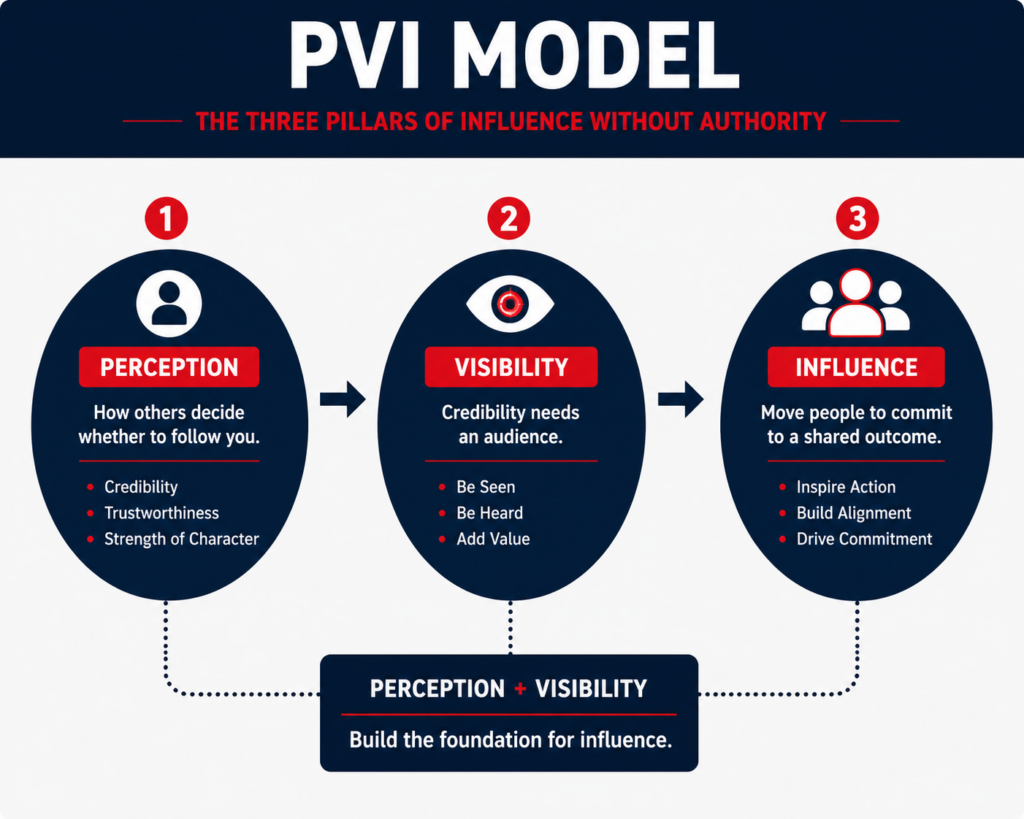
Over the years, I’ve found that influence is built through three interconnected leadership behaviors that I teach through my PVI Model.
The PVI Framework for Influence Without Authority
When leaders ask me how to increase their influence, they’re usually looking for better persuasion techniques.
Instead, I take them somewhere else. Before you can influence someone else’s decisions, you need to understand why they would choose to follow you in the first place.
That’s why I teach influence through my PVI Model: Perception, Visibility, and Influence. Each pillar builds on the one before it, and together they explain why some leaders can influence others regardless of their title, while others struggle despite having formal authority.
PERCEPTION: How Others Decide Whether to Follow You
Perception is the foundation. Before anyone will follow your lead across a reporting line, they have to see you as credible, trustworthy, and worth the risk of cooperating with.
If stakeholders consistently see you as thoughtful, collaborative, and someone who understands the broader business, they’re far more likely to support your ideas and advocate for them when you’re not in the room.
If they see you as someone who pushes an agenda without understanding their challenges, resistance begins before the meeting even starts.
I coached a director who kept running into resistance from a peer in another department. The problem wasn’t her proposal. It was that she was perceived as pushing her own team’s agenda. We worked on seeking input earlier and recognizing the priorities of other teams. Within a few months, that same peer became one of her strongest allies on cross functional initiatives.
VISIBILITY: Credibility Needs an Audience
Visibility is making sure the right people have firsthand experience with your thinking, judgment, and leadership before you need their support.
When stakeholders only hear from you during major initiatives, every request feels transactional.
When they regularly see you contributing thoughtful ideas, helping solve problems, collaborating across departments, and creating value, influence becomes much easier.
One client, a senior engineering leader, was highly respected by his own team but virtually unknown to the sales and product leaders whose buy in he needed for a platform migration. We worked on getting him into the recurring forums where those leaders already met, rather than requesting separate one off meetings that positioned him as an outsider asking for time. Over the following months, he became a familiar voice in those discussions. By the time the migration proposal came forward, he already had the credibility and relationships needed to gain broad support.
INFLUENCE: Leadership Without Positional Power
Influence is what perception and visibility make possible. It is the ability to move people toward a shared outcome without relying on positional power. It is not about having a more persuasive argument. It is the natural outcome of building credibility, strengthening relationships, and showing up consistently where important decisions are made.
This is why the order of the three pillars matters so much. A leader with formal authority can sometimes rely on a title to gain compliance. A leader without that authority cannot. Try to influence a peer before you’ve established credibility, and your ideas are more likely to be dismissed. Try to influence a stakeholder who barely knows you, and you’re asking them to take a risk on someone they don’t yet trust. The sequence is not optional. It is the difference between an idea that gains commitment and one that quietly fades away.
Five Strategies for Leading Without Authority
Through my coaching work, I’ve found that leaders who consistently influence across departments tend to follow the same patterns. They don’t rely on charisma or persuasive presentations. They build influence intentionally long before decisions need to be made.
Here are five strategies I recommend most often.
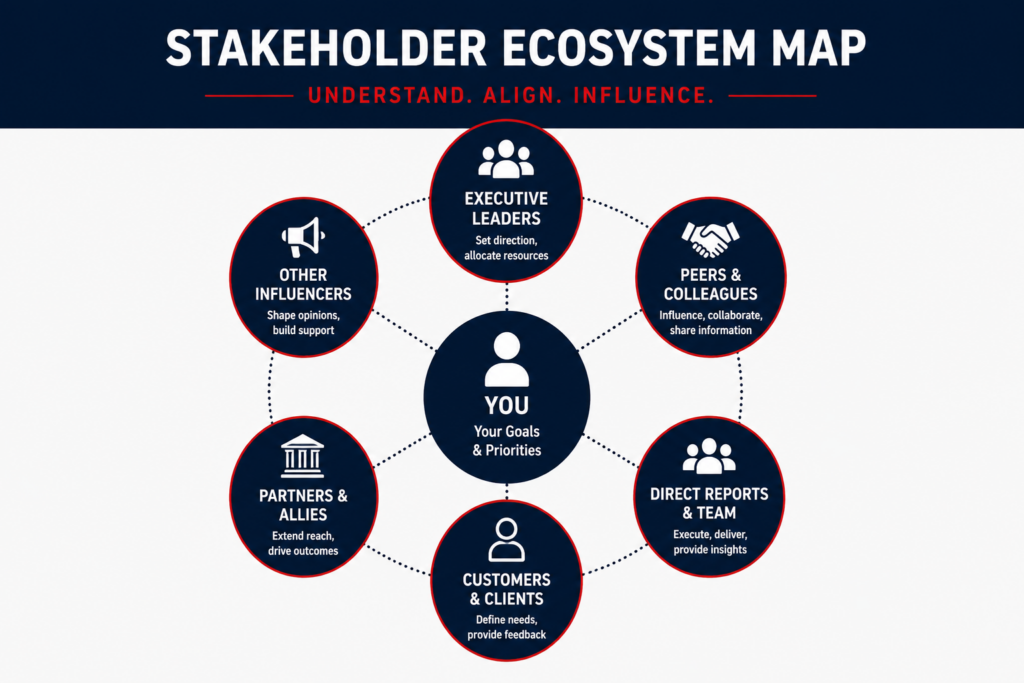
1. Map the stakeholder ecosystem before making your ask.
One mistake I frequently see is that leaders go straight to the person they need something from. That’s usually too late.
Every stakeholder enters a conversation with different priorities, pressures, incentives, and concerns.
Before launching any initiative, map not only the decision maker but also the people who influence that decision behind the scenes. Many of the most influential people don’t appear anywhere on the organizational chart.
This mirrors the stakeholder ecosystem mapping approach described by Hult Ashridge, which emphasizes understanding both formal reporting relationships and the informal networks that influence decisions.
I make it practical by asking clients one simple question: What does this person need to accomplish, and how can my initiative help them achieve it?
One CHRO I coached assumed the CFO would determine whether her proposal moved forward. After mapping the stakeholder ecosystem, she realized the CFO’s chief of staff was the person shaping many of those decisions before they ever reached the CFO. She shifted her early conversations and built support there first, and the proposal gained momentum much faster.
2. Lead with questions, not answers.
Many leaders think they need to arrive with the solution.
When you present a fully formed recommendation, peers who have no obligation to follow you have little reason to invest in it. When you begin with thoughtful questions, you invite them to help shape the solution, creating a sense of ownership from the start.
One product leader I coached shifted from opening meetings with recommendations to asking, “Here’s the problem as I see it. What am I missing?” Instead of defending her ideas, stakeholders began contributing to them. The discussions became more collaborative, objections surfaced earlier, and gaining buy in became much easier.
When people feel they’ve helped shape an idea, they’re far more likely to support its implementation.
Instead of saying: “Here’s what we need to do.”
Try asking:
- What concerns do you think we’ll need to address?
- What would success look like from your team’s perspective?
- What obstacles do you see that we should plan for?
You’re not giving up leadership. You’re creating ownership.
3. Build credibility through small wins before requesting large commitments.
Influence is rarely earned during one important meeting. It’s built over dozens of smaller interactions.
Leaders often make the mistake of asking for significant support before they’ve established a track record of collaboration.
Instead, look for opportunities to solve problems, share useful information, and help other teams succeed before asking for their commitment.
One executive I coached wanted support for a major technology initiative. Rather than immediately asking department leaders to commit resources, she spent several months helping those same leaders solve smaller operational challenges. By the time she presented the larger initiative, they already trusted her judgment and were far more willing to support her recommendations.
Relationships create influence long before they create agreement.
4. Communicate in the language of the person you are trying to influence.
One of the fastest ways to lose influence is to communicate from your own priorities instead of theirs.
Different leaders evaluate ideas through different lenses.
Finance looks for business impact and return on investment. Engineering evaluates scalability and technical risk. Operations focuses on execution. HR considers the impact on people and culture.
Too many leaders deliver the same message to every audience.
Influential leaders adapt their message without changing their objective.
The more your recommendation helps others accomplish their goals, the easier it becomes for them to support yours.
5. Make other people successful.
One of the most overlooked ways to build influence is to help other people succeed.
Leaders naturally gravitate toward colleagues who make them look good, solve problems, and create opportunities rather than competition.
That means recognizing the contributions of other teams, sharing credit generously, introducing colleagues to valuable connections, and celebrating wins that aren’t your own.
When people know you’ll help them succeed, they’re far more willing to support your priorities when you need their help.
Over time, that’s how influence is earned.
Three Mistakes Leaders Make When Influencing Without Authority
Over the years, I’ve seen three mistakes repeatedly undermine otherwise capable leaders.
- They rely on logic instead of relationships. A great business case rarely overcomes a lack of trust.
- They wait until they need support before building relationships. By then, every conversation feels transactional.
- They treat every stakeholder the same. Different leaders care about different outcomes. The more you tailor your message to their priorities, the easier it becomes to build commitment.
None of these mistakes are difficult to correct. But recognizing them is the first step toward building influence without authority.
Leading Without Authority: Real Coaching Examples
The principles I’ve shared become much easier to understand when you see them in practice. Here are three examples from my executive coaching work.
A VP of Product who needed three departments to move together
A VP of Product was responsible for launching a major platform enhancement. Engineering, Sales, and Marketing all needed to align, yet none of those teams reported to her.
Initially, she assumed a strong business case would be enough. It wasn’t enough.
During coaching, we shifted the strategy. Instead of leading with the project plan, she met individually with each stakeholder to understand their priorities, concerns, and success measures. She adjusted the rollout so each department could clearly see how the initiative supported its own objectives.
The project gained broad support because it stopped feeling like Product’s initiative and became a shared business priority.
A Marketing Director who needed sales to change
A marketing director developed a new lead scoring model that would significantly improve how sales prioritized opportunities. The challenge was that the sales organization had no obligation to adopt a process designed by Marketing.
Instead of pushing for a company-wide rollout, we focused on building credibility with several regional sales managers whom the sales team already trusted. We piloted the new approach in one region, generated measurable business results, and let those sales leaders share the success with their peers. By the time the broader rollout was proposed, support came from within the sales organization rather than from Marketing, making adoption much faster and far less contentious.
A Newly Promoted SVP navigating a matrix organization
A newly promoted SVP inherited responsibility for several strategic initiatives but had very little direct authority over the leaders responsible for executing them.
His instinct was to move quickly. Instead, we slowed down.
For his first several weeks, he focused almost entirely on relationship building. He met individually with key stakeholders, listened more than he spoke, and looked for opportunities to help other leaders achieve their goals before asking for support.
By the time his first major initiative launched, he wasn’t relying on his title. He was relying on the trust and credibility he had intentionally built.
Ready to Strengthen Your Influence?
If you’re finding it difficult to gain commitment from peers, stakeholders, or senior executives, the issue may not be your ideas. More often, it’s how you’re perceived, where you’re visible, and how you’re building influence before the conversation begins. Discover how my Lead With Influence executive coaching helps senior leaders build credibility, gain stakeholder buy in, and drive change across the organization.
How Executive Coaching Develops Influence Without Authority
Developing influence without authority requires more than understanding the concepts. It requires changing how you show up with the people whose support matters most.
That’s why my coaching starts with your actual stakeholder ecosystem, not generic scenarios. Through 360 feedback and stakeholder conversations, we identify the perception gaps that may be limiting your influence. From there, we prepare for real stakeholder conversations before they happen, refine your approach, and build accountability for the behaviors that strengthen trust and credibility over time. Unlike generic influence without authority training, every coaching engagement is built around your actual stakeholders, priorities, and leadership challenges.
The leaders who succeed aren’t the ones who wait for their title to catch up with their responsibilities. They’re the ones who intentionally build the perception, visibility, and influence to lead outcomes regardless of what the organizational chart says.
If you’re looking to strengthen your ability to influence peers, gain stakeholder buy in, and lead effectively across your organization, executive coaching can help you build those skills in a practical, measurable way.
Final Thoughts
The leaders who create the greatest impact aren’t always the ones with the biggest titles or the largest teams. They’re the ones who consistently earn trust, build relationships, and align people around a shared purpose.
That’s what influence without authority is really about. When you strengthen how people perceive you, increase your visibility with the right stakeholders, and intentionally build influence over time, your title becomes far less important than your ability to earn commitment.
You become the kind of leader people choose to follow.
If influencing peers, gaining stakeholder buy in, or leading across a matrix organization has become one of your biggest leadership challenges, I’d be happy to learn more about your leadership goals and discuss how executive coaching can help you build greater influence.
|